Preventing Falls: How Multidisciplinary Care and Technology Support Safer Gait
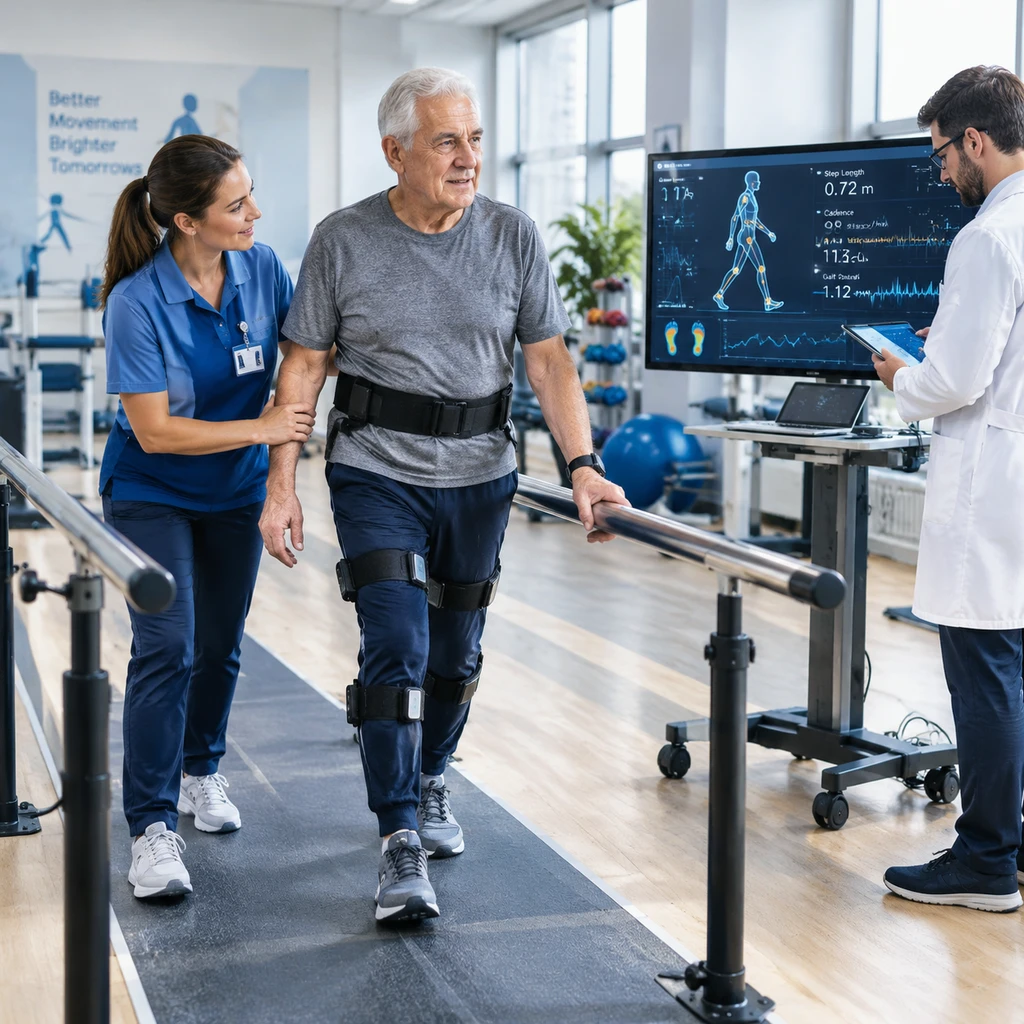
Fall prevention works best when care teams look beyond a single symptom or device. Gait, balance, health conditions, medications, confidence, and the places a person moves through can all shape fall risk. Coordinated assessment helps connect these factors to practical rehabilitation goals.
Technology can add useful information to that work. Wearable sensors and mobility monitoring may help clinicians observe movement during training and daily activity, but they do not replace clinical judgment or person-centered care. The aim is safer, more confident movement through a plan suited to the individual.
Why fall prevention calls for a coordinated approach
Fall prevention calls for coordinated care because walking and balance depend on several interacting factors, including strength, sensation, health, medication effects, and the environment. A multidisciplinary approach helps identify which factors matter most for each person and links them to appropriate support.
A change in gait may have more than one cause. A person might shorten their steps because of pain, feel unsteady when turning because of impaired balance, or walk less after a recent fall because of fear. Vision changes, fatigue, footwear, and chronic conditions can add further challenges. Treating only one piece may leave other risks untouched.
A multidisciplinary care team can connect clinical findings with everyday function. The team may set shared priorities such as rising from a chair safely, turning in a narrow space, or walking outdoors with less hesitation. This is more useful than relying on a general goal like “improve balance” without specifying the activity that matters to the person.
Coordination also helps keep plans realistic. A device that works in a clinic may not suit someone’s home or routine, while an exercise that appears appropriate on paper may need adapting for pain or fatigue. Fall prevention is therefore an ongoing process of assessment, practice, and adjustment, not a one-time checklist.
Assessing gait and individual fall risk
Fall-risk assessment combines a person’s history, clinical observation, and functional tests to understand how they move and where difficulties arise. Physical therapists and other clinicians use this information to guide a person-centered plan rather than assuming that one test or score captures every risk.
Assessment often begins with questions about previous falls, near-falls, dizziness, injuries, concerns about walking, and the situations in which instability occurs. A clinician may review relevant health conditions, medication concerns, vision or sensory changes, and the person’s goals. These details help put movement findings in context.
During gait observation, a physical therapist may look at walking speed, step length, symmetry, foot clearance, posture, turning, and the need for support. Functional tasks can include standing from a chair, changing direction, stepping over an obstacle, or walking while attending to another task. The specific assessment should match the person’s abilities and clinical needs; not every test is suitable for everyone.
Assessment is most helpful when it identifies a modifiable problem. For example, difficulty clearing the feet may lead the therapist to examine strength, joint movement, sensation, and footwear before choosing an intervention. A baseline record also makes later comparisons more meaningful, especially when the team tracks the same task under similar conditions.
The multidisciplinary team’s role
A multidisciplinary team supports fall prevention by combining expertise in movement, health, medication, equipment, and daily function. The exact team varies by person, but clear communication helps ensure that recommendations work together rather than compete.
Physical therapists commonly assess gait and balance, prescribe and progress gait training, and help select or adjust exercise challenges. Occupational therapists may consider how daily activities and the person’s routines affect mobility. Physicians, nurses, pharmacists, and other clinicians can contribute by reviewing health conditions, symptoms, and medications that may affect steadiness or alertness.
Other professionals may also be relevant. A rehabilitation engineer or assistive-technology specialist can help evaluate mobility equipment or sensor systems. Care partners can describe how a person manages at home and what tasks feel difficult, with the person’s consent. Their observations add context but should not replace the individual’s own priorities or a clinician’s assessment.
Good coordination means agreeing on a small set of goals, sharing relevant observations, and deciding who will follow up. If a person reports new dizziness or a sudden change in walking, the response may need clinical review rather than simply increasing exercise. Teamwork is valuable precisely because it helps match the next step to the cause.
Technology in gait training and fall prevention
Technology can support gait training and fall prevention by capturing movement, providing feedback, or helping clinicians monitor activity over time. Wearable sensors and other tools offer additional information, but they cannot diagnose every cause of instability or guarantee that falls will be prevented.
Wearable sensors may be placed on the waist, wrist, or legs to record movement features such as steps, walking bouts, or changes in activity. In a rehabilitation setting, sensors can help compare movement during repeated tasks or provide feedback during practice. Some systems support mobility monitoring outside the clinic, although the information they collect varies by device.
Other tools include instrumented walkways, video-based movement analysis, balance platforms, and interactive training systems. These can help therapists observe aspects of walking or balance that are difficult to capture by memory alone. Their value depends on the question being asked: a detailed sensor report is of limited use if it does not change the training plan or help the person reach a meaningful goal.
There are trade-offs. Sensors may be uncomfortable, difficult to set up, or less reliable when used inconsistently. Data can also be affected by device placement and the context in which movement occurs. Clinicians should explain what is measured, how information will be used, and who can access it. Technology should inform decisions, not make them on its own.
Turning assessment into a tailored intervention
A tailored intervention uses assessment findings to select gait training, balance practice, assistive devices, and other supports that fit the person’s abilities and goals. The plan should start at a safe challenge level, then progress as function and confidence allow.
Gait training may include repeated practice of walking, turning, starting and stopping, stepping over obstacles, or changing speed. Balance training can target standing control and weight shifting. Strength and mobility exercises may also help when assessment identifies relevant limitations. A therapist chooses the task, support, and level of difficulty based on the person’s health, symptoms, and response to practice.
Progression should be deliberate. A clinician might first practise turns in a clear space with close supervision, then add a wider range of directions or a more demanding environment if the person can manage safely. Adding complexity too quickly can increase risk or reduce movement quality. The appropriate pace differs across individuals.
Assistive devices, such as canes or walkers, may improve support for some people, but a device is helpful only when it fits the person and is used correctly. Physical therapists can assess device height, technique, and whether it suits the person’s typical walking situations. The person should have time to practise using it before relying on it during more demanding activities.
Personalized rehabilitation also includes preferences and access. A program that requires travel the person cannot manage or equipment they cannot use is unlikely to fit daily life. The team can adapt exercises, supervision, and technology to the person’s setting while keeping safety and functional goals in view.
Evaluating progress and addressing practical barriers
Progress is evaluated by repeating relevant assessments, reviewing daily function, and asking whether the person’s goals are becoming easier or safer to achieve. Mobility monitoring can add context, but results need to be interpreted alongside clinical observations and the person’s experience.
Useful measures might include how steadily someone completes a chosen walking task, how much support they need, or whether they can manage a turn with greater control. The team can record the conditions of each assessment, such as the footwear, assistive device, and level of supervision. That makes change easier to interpret.
Technology can make monitoring more convenient, but access and usability matter. A sensor may need charging, a smartphone, reliable connectivity, or help with placement. Some people may prefer not to wear a device or share activity data. Clinicians should offer alternatives, explain privacy practices, and avoid treating missing data as proof that someone did not practise.
One practical framework is to review fit, function, and follow-up: Does the tool or intervention fit the person’s needs and routine? Does it provide information or support that changes care? Is there a plan to review results and adjust the approach? If any answer is no, the team should reconsider the setup rather than adding more technology.
Frequently asked questions
How can gait training support fall prevention?
Gait training gives a person supervised practice with walking tasks that match their assessment and goals, such as turning or clearing obstacles. It can help clinicians target specific movement challenges, but its content and supervision should be individualized.
What professionals may be involved in a fall-prevention plan?
Depending on a person’s needs, the team may include physical therapists, occupational therapists, physicians, nurses, pharmacists, rehabilitation specialists, and care partners. The right mix depends on the factors affecting mobility and the support required.
How can wearable sensors contribute to mobility monitoring?
Wearable sensors can record selected movement or activity patterns over time, providing information that may complement in-person gait assessment. Their readings need context, since device placement, wear time, and daily conditions can affect the data.
Can technology replace an in-person fall-risk assessment?
No. Technology can support observation and monitoring, but it cannot fully evaluate a person’s medical history, symptoms, functional goals, or safe use of assistive devices. It works best as one part of a coordinated clinical approach.