How FP7 Projects Are Advancing Fall Prevention Technologies for Elderly People
The Growing Challenge of Falls Among the Elderly
Falls represent one of the most serious and costly health threats facing older adults today. For people over 65, a single fall can trigger a cascade of consequences — fractures, hospitalisation, loss of independence, and a persistent fear of falling that further reduces mobility and accelerates physical decline.
The scale of the problem is significant. Across Europe, falls are the leading cause of injury-related death among older adults, and healthcare systems bear enormous costs from emergency care, surgery, and long-term rehabilitation. Beyond the clinical burden, there is a profound human cost: many older adults who fall never fully regain their previous level of activity.
What makes this challenge particularly urgent is its demographic trajectory. As Europe's population ages, the number of people at high fall risk is growing steadily. Reactive approaches — treating injuries after they occur — are neither sustainable nor sufficient. This is precisely why proactive fall prevention, grounded in research and supported by structured funding frameworks, has become a priority for European health policy and innovation.
What Is the FP7 Programme and Why It Matters for Healthcare Innovation
The Seventh Framework Programme (FP7) was the European Union's primary instrument for funding scientific research and technological development from 2007 to 2013, with a total budget exceeding €50 billion. It was designed to strengthen Europe's knowledge base, foster cross-border collaboration, and translate research into real-world applications — including in healthcare and assistive technology.
For healthcare innovation, FP7 was particularly valuable because it funded not just basic science but applied, translational research with clear societal relevance. Projects addressing ageing, disability, and rehabilitation were explicitly prioritised under the programme's health and ICT themes. This created a structured pathway for researchers to develop, test, and refine technologies that might otherwise struggle to attract commercial investment at early stages.
The programme's collaborative model required consortia of institutions — universities, hospitals, technology companies, and research centres — to work together across national boundaries. This structure brought together engineering expertise, clinical knowledge, and gerontological insight in ways that single-institution projects rarely achieve. For a complex challenge like fall prevention, that interdisciplinary depth is not optional — it is essential.
You can learn more about the programme's structure and legacy through the European Commission's CORDIS research portal, which archives FP7 project outcomes and publications.
Mechatronic Gait-Training Devices — A New Frontier in Fall Prevention
A mechatronic gait-training device combines mechanical engineering, electronics, and software control to actively assist and correct a person's walking pattern in real time. Unlike passive walking aids, these systems do not simply support weight — they analyse movement and provide targeted feedback or physical assistance to retrain the neuromuscular pathways that govern safe, stable gait.
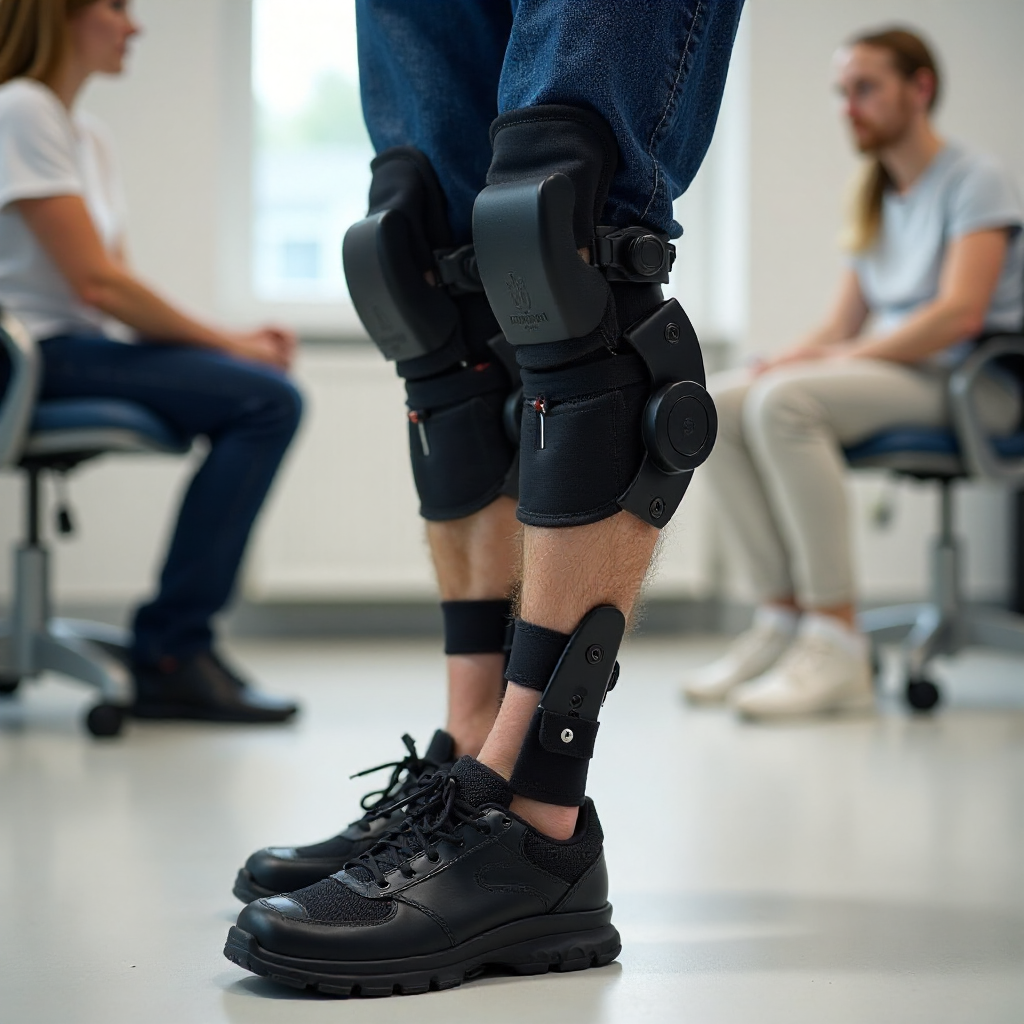
The connection to fall prevention is direct. Most falls in older adults are not random accidents — they result from specific, measurable deficits: reduced step length, poor ankle dorsiflexion, delayed balance recovery, or asymmetrical weight distribution. Gait analysis can identify these deficits with precision. Mechatronic systems can then target them with structured, repetitive training that the nervous system responds to over time.
This active intervention model stands in contrast to passive monitoring approaches, which detect falls after they happen or flag risk without providing a therapeutic response. Gait training works upstream of the fall event itself, addressing the biomechanical vulnerabilities that make falls likely. That distinction — between observation and intervention — is central to why FP7-funded researchers have invested in mechatronic solutions rather than sensor-only systems.
The engineering challenge is considerable. A device that must operate safely on a frail older adult, adapt to individual movement patterns, and function reliably across varied environments requires sophisticated sensor fusion, control algorithms, and mechanical design. FP7 funding provided the research runway to develop these systems beyond proof-of-concept into clinically testable prototypes.
How FP7-Funded Research Is Shaping Gait Rehabilitation Approaches
FP7 projects in fall prevention have pursued a research methodology that integrates sensor technology, biomechanical modelling, and adaptive control systems into a coherent rehabilitation framework. The goal is not simply to build a device — it is to understand how gait deteriorates with age and design interventions that reverse or slow that deterioration.
Central to this work is the use of wearable sensors — inertial measurement units, pressure insoles, electromyography electrodes — that capture movement data during both training sessions and daily activity. This continuous data stream allows researchers to track changes in gait parameters over weeks and months, providing objective evidence of rehabilitation progress that clinical observation alone cannot deliver.
Real-time feedback systems are another critical component. When a device detects that a user is adopting a compensatory gait pattern — perhaps favouring one leg to protect a painful joint — it can provide haptic, auditory, or visual cues to correct the movement before it becomes habitual. This closed-loop approach, where the device responds to the user's actual movement rather than following a fixed programme, reflects the state of the art in balance rehabilitation research.
FP7 projects have also invested in personalisation frameworks. Older adults are not a homogeneous group: their gait deficits, cognitive capacity, physical fitness, and rehabilitation goals vary enormously. Research under FP7 has developed assessment protocols and adaptive algorithms that tailor training intensity and focus to the individual, rather than applying a one-size-fits-all programme.
Collaborative Research Consortia — Bringing Together Expertise Across Europe
The multidisciplinary consortium model is one of FP7's most distinctive features, and in fall prevention research it is particularly well-suited to the complexity of the problem. No single institution has all the expertise needed to develop, validate, and deploy a mechatronic gait-training system — the work spans biomechanical engineering, clinical physiotherapy, geriatric medicine, software development, and regulatory science.
A typical FP7 fall prevention consortium might include a technical university developing the device hardware and control algorithms, a hospital providing clinical expertise and patient access for trials, a research institute specialising in ageing and mobility, and a technology company responsible for manufacturability and commercialisation pathways. Each partner contributes a distinct capability, and the collaboration produces outcomes that none could achieve independently.
This structure also builds in a form of quality control. When engineers propose a design change, clinicians can immediately assess its practical implications for patient safety or usability. When physiotherapists identify a training gap, software teams can adjust the feedback algorithms. The iterative dialogue between disciplines accelerates development and reduces the risk of building technically impressive systems that fail in clinical practice.
Geographic diversity across the consortium matters too. Recruiting participants from different European countries exposes the research to varied healthcare contexts, rehabilitation traditions, and patient populations — strengthening the generalisability of findings and preparing the technology for pan-European deployment.
From Lab to Life — Clinical Validation and Real-World Impact
Moving from a research prototype to a clinically validated assistive technology is one of the hardest transitions in medical device development. FP7 projects address this explicitly by requiring a structured progression from laboratory testing through pilot studies to broader clinical validation.
Early-phase work focuses on safety and feasibility: can the device operate reliably on older adults without causing harm or discomfort? Pilot studies with small patient groups provide initial data on usability, tolerance, and preliminary effectiveness. These studies also generate the qualitative insights — from patients, caregivers, and physiotherapists — that inform iterative design improvements.
Larger clinical validation studies then test whether the intervention produces measurable improvements in gait parameters, balance scores, and fall incidence compared to standard care. This evidence base is essential not only for regulatory approval but for healthcare system adoption: commissioners and payers need robust data before integrating a new technology into rehabilitation pathways.
The real-world impact extends beyond individual patients. By demonstrating that structured gait training with mechatronic assistance can reduce fall risk, FP7 projects contribute to a broader shift in how healthcare systems approach ageing — from managing decline to actively supporting functional capacity. That shift has policy implications that reach well beyond the duration of any individual project.
The Future of Fall Prevention Technology Beyond FP7
The research foundations laid by FP7 projects continue to shape the field long after the programme's formal end. Technologies developed and validated under FP7 funding have fed into subsequent EU research frameworks, informed clinical guidelines, and attracted commercial investment that the original research phase could not have secured alone.
The trajectory points toward greater integration and miniaturisation. Future mechatronic gait-training systems are likely to be lighter, more discreet, and capable of operating in home environments rather than only clinical settings. Advances in machine learning will enable more sophisticated personalisation — devices that learn an individual's movement patterns over time and adjust training protocols accordingly.
Wearable sensor technology will play an expanding role, enabling continuous monitoring of gait quality between formal training sessions and alerting clinicians to deterioration before it reaches a critical threshold. This shift from episodic to continuous care represents a fundamental change in rehabilitation medicine — and FP7-funded research has been instrumental in demonstrating its feasibility.
The policy influence of this research is also significant. Evidence generated by FP7 consortia has informed European Commission recommendations on active ageing and fall prevention, helping to build the case for sustained public investment in assistive technology research. The programme's legacy, in this sense, is not just the devices it helped create — it is the research culture and evidence base it established.
Frequently Asked Questions
What is an FP7 project and how does it differ from other EU funding programmes?
FP7 was the EU's main research funding programme from 2007 to 2013, succeeded by Horizon 2020 and later Horizon Europe. Unlike structural funds focused on regional development, FP7 specifically targeted scientific excellence and innovation, requiring competitive peer review and international consortium partnerships.
How does a mechatronic gait-training device help prevent falls in elderly people?
These devices use sensors to analyse walking patterns in real time and provide mechanical assistance or corrective feedback to retrain the neuromuscular systems responsible for stable gait. By addressing the biomechanical deficits that cause falls — rather than simply monitoring for them — the technology works preventively rather than reactively.
What role do wearable sensors play in fall prevention research?
Wearable sensors capture objective, continuous data on movement quality, balance, and muscle activity. In research settings, they provide the granular measurements needed to assess training effectiveness. In clinical deployment, they enable remote monitoring and early detection of gait deterioration between rehabilitation sessions.
Who participates in an FP7 fall prevention research consortium?
Consortia typically include universities with engineering and biomedical expertise, hospitals or rehabilitation centres providing clinical access and medical knowledge, specialised research institutes focusing on ageing or biomechanics, and technology companies responsible for device development and eventual commercialisation.
How long does an FP7-funded project typically run and what are its deliverables?
Most FP7 projects ran for three to five years. Deliverables generally include published research findings, working prototypes or validated technologies, clinical study data, and dissemination activities aimed at both the scientific community and policymakers. Projects are also required to report regularly to the European Commission on progress against agreed milestones.